Excellence doctoral scholarships
One of the most important academic research institutes in marine sciences in Canada, the Institut des sciences de la mer (ISMER) of the Université du Québec à Rimouski (UQAR) launches a prestigious excellence scholarship program intended for students from Quebec, other Canadian provinces or internationally.
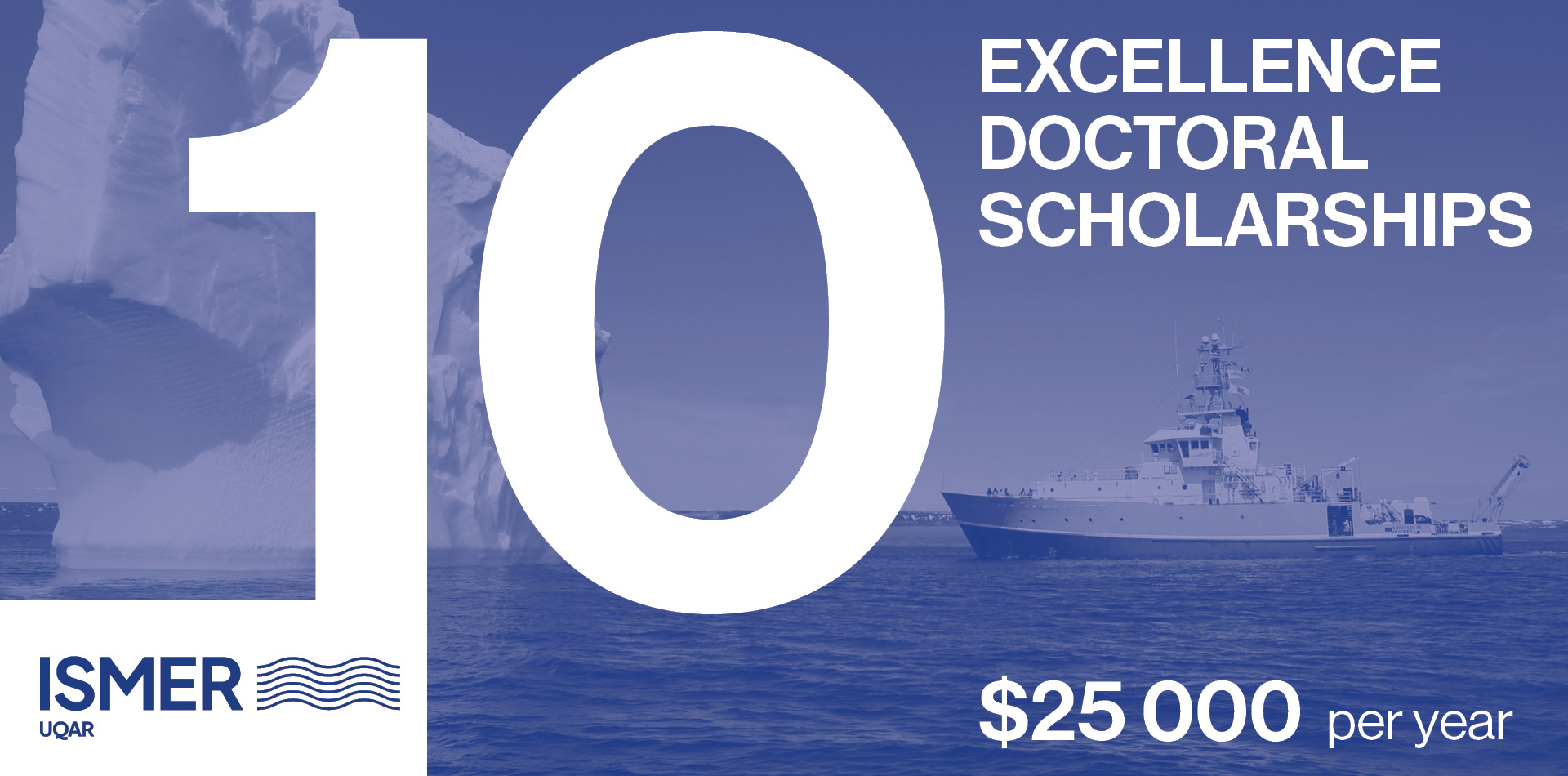
Photo : Marie Guilpin
This scholarship program aims to recruit up to 10 new doctoral students beginning full-time studies at ISMER-UQAR in Fall 2027 or Winter 2028.
Each scholarship is valued at $25,000 per year for three years, for a total of $75,000.
An international tuition fee exemption scholarship may also be available, where applicable, allowing eligible international students to pay the same tuition fees as Quebec students.
Research projects accepting applications will be posted from November 23, 2026, to February 5, 2027.
Project Background: Coastal blue carbon ecosystems, such as salt marshes and seagrass meadows, are widely recognized for their role in carbon sequestration through the accumulation and burial of organic matter. However, their contribution to the carbon cycle may extend well beyond sedimentary carbon storage. Organic matter remineralization and diagenetic reactions within sediments can generate total alkalinity (TA), which can subsequently be transferred to coastal waters. By budering the marine carbonate system, this alkalinity can increase the overall capacity of the coastal ocean to store inorganic carbon and, under certain conditions, promote the uptake of atmospheric CO2. This blue-carbon benthic alkalinity pump remains a poorly quantified component of blue carbon, particularly in subarctic environments that are highly vulnerable to climate change.
Project Description: This project aims to determine the role of total and non-carbonate alkalinity in the carbon cycle of subarctic coastal ecosystems, from its production within sediments to its export to the ocean. It will also establish links between natural alkalinity-generating processes and emerging approaches for artificially increasing ocean alkalinity (Ocean Alkalinity Enhancement, OAE). The overarching objective is to understand and quantify the benthic alkalinity pump in subarctic coastal ecosystems and assess its contribution to the ocean’s capacity for carbon sequestration.
More specifically, the project is structured around three main objectives:
- Characterize total alkalinity as a central diagnostic variable of the marine carbonate system by documenting its spatial and seasonal variability and its relationships with DIC, pH, pCO2, and carbonate saturation states in subarctic coastal environments;
- Identify and quantify the benthic processes responsible for alkalinity production and consumption, to determine the mechanisms controlling its accumulation and persistence, and to use these natural systems as analogues to better understand and constrain Artificial Ocean Alkalinization (AOA) and Ocean Alkalinity Enhancement (OAE) approaches;
- Quantify alkalinity production and export by blue carbon ecosystems, particularly salt marshes and seagrass meadows, to assess the extent to which this alkalinity can be transferred to the coastal waters of the St. Lawrence and contribute to long-term carbon sequestration.
Approaches and Methodology: The project will include: 1) seasonal fieldwork across contrasting subarctic coastal environments, including salt marshes, seagrass meadows, and intertidal flats; 2) characterization of the carbonate system (TA, DIC, pH, pCO2, Ω) and the major diagenetic processes controlling alkalinity production (O2, Fe, Mn, S, N, Ca); 3) porewater profiling and sediment incubation experiments to quantify benthic TA and DIC fluxes; and 4)
biogeochemical mass-balance approaches linking benthic alkalinity production to its coastal export using natural radioisotope tracers (radon and radium), and to its potential contribution to CO2 sequestration.
Candidate Profile:
- Master’s degree in oceanography, biogeochemistry, environmental chemistry, geochemistry, or a related
field; - Strong interest in fieldwork and marine biogeochemistry;
- Skills in data analysis and processing;
- Autonomy, scientific rigour, curiosity, and a strong interest in climate change-related research.
The successful candidate will be based at ISMER-UQAR under the supervision of Gwénaëlle Chaillou, with cosupervision by Fanny Noisette (ISMER-UQAR) and Pierre Anschutz (EPOC, University of Bordeaux, France). The student will also benefit from established collaborations developed through the TCA Apogée Program, including Natalya Evans (OFI, Dalhousie University, NS), Chris Algar (OFI, Dalhousie University, NS), and Philippe Archambault (Biology, Université Laval, QC).
For further information about the project, prospective candidates are encouraged to contact Gwénaëlle Chaillou (gwenaelle_chaillou@uqar.ca) before the ISMER selection process.
The final application must include a complete CV (including scientific presentations and publications, scholarships, awards, research cruises, etc.); a statement of motivation describing the candidate’s academic and research background and explaining how their experience and interests align with the proposed project and the ISMER PhD program in Oceanography; all university transcripts; a letter of support from the professor leading the proposed project; and three (3) letters of recommendation, including at least one from a current or former research supervisor.
All documents must be submitted electronically.
The oceans play a key role in climate regulation, having absorbed approximately 25% of anthropogenic CO2 emissions since the pre-industrial era (Friedlingstein et al., 2020), with the North Atlantic accounting for 30% of this amount (Gruber et al., 2023). However, estimates based on models, surface data, or interior ocean data do not align (Hauck et al., 2023), suggesting that certain elements of marine carbon storage remain poorly understood. Recently, studies have suggested that extreme events—defined as unusual and short-duration conditions—alter the oceans’ capacity to absorb and sequester carbon. For instance, marine heatwaves (Li et al., 2024; Edwing et al., 2024; Mignot et al., 2022) and storms (Carranza et al., 2024; Nicholson et al., 2022; Toolsee et al., 2024; Turner et al., 2025) decrease gas fluxes between the sea and the atmosphere, with repercussions for long-term carbon storage (Gregor et al., 2024; Prend et al., 2025). Yet, marine heatwaves in particular are becoming increasingly frequent (Frölicher et al., 2018; Gruber et al., 2021). Understanding the impact of these events on the carbon cycle is therefore essential to reduce the significant uncertainty surrounding the amount of carbon absorbed by the oceans, thereby improving climate projections..
The presence of marine heatwaves in the Northwest Atlantic and its connected seas, including the St. Lawrence Estuary and Gulf, has not been characterized. Nevertheless, the St. Lawrence Estuary and Gulf represents a particularly compelling local laboratory for studying these changes, as it allows for rapid field deployment during such events.
The objective of the proposed project is to assess the impact of marine heatwaves on carbon storage and sequestration in the North Atlantic. More specifically, the role of various physical processes (e.g., increased stratification, reduced solubility) and biogeochemical processes (e.g., respiration, production) will be quantified. These analyses will be carried out using observations from major public databases (biogeochemical Argo floats, Global Ocean Data Analysis Project, Surface Ocean CO2 Atlas, satellite data) as well as dedicated field campaigns conducted in the St. Lawrence Estuary or Gulf during the summer of 2027 or 2028. More specifically, the student will be expected to: (I) characterize the presence, frequency, and intensity of marine heatwaves in the North Atlantic and its adjacent seas; (II) quantify the effect of these heatwaves on air-sea CO2 fluxes and identify the dominant processes; (III) quantify the effect of these heatwaves on long-term carbon storage by linking the surface to the interior ocean, and identify the dominant processes.
The project will be conducted in collaboration with national and/or international partners. For any questions, please contact: mathilde_jutras@uqar.ca
The doctoral thesis must be conducted under the supervision of an ISMER regular faculty member or grant-funded professor.
Applicants must secure a research supervisor prior to admission and obtain a letter of support from the professor responsible for one of the available projects.
To be eligible, applicants must meet the following criteria:
- Meet the admission requirements of UQAR’s PhD program in Oceanography;
- Hold a cumulative GPA of at least 3.7/4.3, or the equivalent, for the degree submitted in support of the admission application (e.g., an M.Sc. degree in natural sciences or engineering);
- Submit an application for admission in order to begin the PhD in Fall 2027 or Winter 2028;
- Be enrolled full-time in the PhD in Oceanography program at the time the scholarship is awarded.
Interested applicants must submit:
- a complete curriculum vitae (including scientific presentations, scholarships, awards, sea-going missions, etc.);
- a statement of intent describing the applicant’s academic background and explaining how it aligns with the proposed project and the PhD in Oceanography at UQAR;
- all university transcripts;
- a letter of support from the professor responsible for one of the available projects;
- three (3) letters of recommendation, including one from the applicant’s research supervisor. [Bourses ISMER | Word]
All documents must be submitted electronically as a single PDF file of less than 10 MB to the Graduate Program Committee in Oceanography at etud_ocean@uqar.ca.
February 5, 2027
Only complete applications meeting the requirements of this scholarship program will be evaluated by the selection committee after the application deadline. ISMER-UQAR is committed to employment equity and strongly encourages applications from women, persons with disabilities, members of visible and ethnic minority groups, and Indigenous Peoples.